
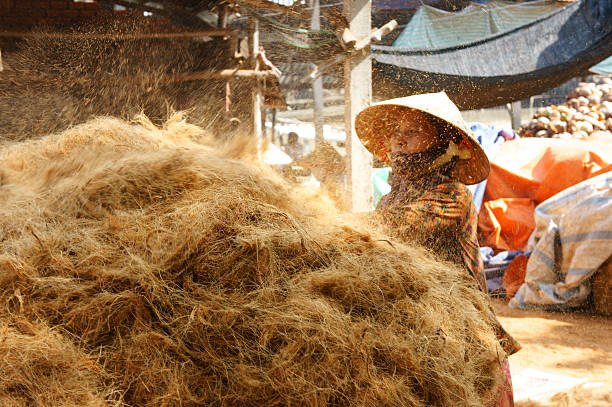
Indonesian coconut fiber products are a popular export commodity. Indonesian families transform coconut fiber into high-value cocopeat and cocofiber exports, turning these “raw gold” materials into lucrative business opportunities. Indonesia’s cocofiber exports are undeniable, with thousands of tons exported to countries in need. China accepts all grades of cocofiber in unlimited quantities. Beyond their agricultural uses, these materials have gained significant traction in the global industrial sector. This international surge in demand has transformed the coconut industry from a local agricultural byproduct into a powerhouse of global manufacturing. Furthermore, the German, European, and American markets now demand cocofiber in large capacities to fuel their sustainable production lines. Manufacturers incorporate processed cocofiber into interior designs and furniture supports, utilizing it for mattress fillings, sofa paddings, and MDF-like coconut fiberboard (CFB).
In the same way, the global horticultural industry has recognized the functional superiority of these materials. Similarly, landscapers use cocopeat as a planting medium and a premium covering for the world’s best golf courses. While many people overlook or discard coconut fiber as roadside trash, this valuable commodity holds significant untapped potential. However, in other areas of life, these items are becoming sought after by foreign markets, such as China, Japan, and Korea.
Manufacturers compact cocopeat pith into bricks for greenhouses, golf courses, and erosion control.Consequently, extensive testing confirms that this unique, eco-friendly medium effectively promotes plant growth. By providing the ideal balance of aeration and moisture, coconut fiber allows root systems to thrive in a way that traditional soils often cannot.
Coconut fiber processing doesn’t stop there; there are things like cocofiber (coconut fiber). Manufacturers extract cocofiber from coconuts to create diverse products for agriculture, industry, and infrastructure.Cocofiber derivatives include cocosheet, cocomesh, and cocopot.
- Cocosheet (Coir Fiber Sheet)
- Manufacturers process coconut fiber into cocosheets, typically producing thicknesses of 1-3 cm and lengths up to 50 meters. Factories can also create custom sizes, transforming this semi-finished material into high-value products.
Manufacturers use cocosheet to create high-export products like wallets, shoes, car seats, and mattresses. International buyers value Indonesian cocosheet because it exceeds global quality standards - The use of cocosheet has various advantages. These advantages include: 1) Environmental benefits.
- Indonesia’s abundant coconut resources provide a permanent, renewable energy source that will never run out. In the industrial sector, cocopeat is capable of sound reduction and noise absorption, especially at high frequencies (2000 Hz). Cocosheets rival glasswool by offering a more cost-effective alternative. Manufacturers produce two distinct types based on composition: natural cocosheets, which utilize 100% coconut fiber, and versions containing specific additives.
LATEX COCOSHEET
- Manufacturers combine coconut fiber with latex sap to create durable cocosheets, utilizing the sap as a natural adhesive.. This adhesive prevents the coconut fiber from easily decomposing from the sheet.
- Cocosheets have a wide and varied application across various industrial sectors, such as agriculture, infrastructure, households, automotive materials, and even the aviation industry. Here’s an explanation of the uses of cocosheets in various industrial sectors…Agricultural Sector
- Farmers use cocosheets as a growing medium for microgreens, harvesting the vegetable shoots within 7 to 21 days once seedlings reach 5-10 cm.. These microgreens contain many nutrients that are good for health. Furthermore, the agricultural and plantation sectors often use cocosheets as ground cover or mulch to protect soil and enhance crop yields.. In addition to keeping plants or gardens clean and tidy, this mulch also provides natural nutrients from coconut fiber, which are also beneficial for weed growth.
2. Cocomulsa
Agriculturalists use Cocomulsa as a natural soil cover to improve soil quality and increase crop yields. This versatile material comes in circular or rectangular shapes, providing farmers with an excellent choice for various planting layouts.
- Cocomulsa Mats – Weed Barrier for Trees
These coco mats are rectangular, measuring 90 x 90 cm, with a slit toward the center for tree planting. Farmers can enlarge the planting hole area to accommodate their growing plants. The use of coir mats is very effective in preventing weeds from competing to grow around trees. Weeds that grow will usually inhibit plant growth because they consume nutrients needed by trees during growth. - The use of coir mulch offers benefits, including maintaining soil moisture, as it reduces groundwater evaporation and prevents snails from approaching trees. Furthermore, coir mulch lasts longer, approximately three years, increasing its economic value compared to plastic mulch, which only lasts two uses.
- Gardening enthusiasts can adjust the size of the coir mat to suit their specific needs for various planting tools.. Smaller plants can use smaller coir mulch disks.
- Infrastructure Sector
Engineers and contractors use cocosheets for building materials and road infrastructure in the following ways.
a. Landscaping
In the infrastructure and landscaping sectors, contractors commonly use cocosheet to construct green spaces and stabilize road embankments.Cocosheet functions as a layer between soil and rock to prevent the rock from directly mixing with the soil, thus minimizing rock shifts that could cause landslides or uneven roads.
Waterproofing
Construction workers apply waterproofing as a watertight layer to seal roofs, bathrooms, basements, and swimming pools. Additionally, artisans use cocosheet to reinforce sculptures, cement-based molded columns, and various decorative structures. Most synthetic materials synthesize waterproofing as fibers. However, for environmental reasons, many are still seeking environmentally friendly fiber materials.
Automotive Sector
The automotive and aerospace industries utilize cocosheets for car and motorcycle seats, airplane and train cabins, and high-performance soundproofing.
Car Seats
European car manufacturers also use cocosheet as a critical layer in their car seat production processes. In line with global environmental issues, the car seat manufacturing industry must now begin incorporating sustainable materials into its products, given their renewable nature.
Leading global automotive manufacturers, such as Mercedes-Benz, Volkswagen, Porsche, and Opel in Europe, actually use coconut fiber to fill car seats. Coconut fiber has also found success in the automotive interior market, particularly in the car seat category. Aerospace engineers currently use coconut fiber as a primary material for airplane seats.. Besides being a flexible, environmentally friendly material, coconut fiber has very low biodegradability, making it an excellent choice for filling four-wheeled vehicle seats.
Soundproofing
Industries use processed cocosheet products to soundproof industrial machinery and aircraft cabins. Engineers have researched developing cocosheet into Coconut Fiber Composite (CFC) for aircraft construction, replacing the fiberglass and matrix materials typically found in wing formulations. This innovative material effectively minimizes impact when subjected to heavy loads.
Household Needs Sector
Manufacturers use cocosheet as a versatile material for household products. By combining coconut fiber (cocofiber) with natural latex, they produce flexible and pliable natural mattresses for spring beds. Both are environmentally friendly and an excellent alternative to synthetic materials. Beyond mattresses, manufacturers often use cocosheet for sofa upholstery, spring bed lining, foot mats, and floor mats.. This coir mat has a rough texture, helping to remove dirt from footwear. Manufacturers typically color or restore coconut fiber mats to their natural shade to enhance their visual appeal.
Hobby Sector (Cocosheet as Animal Cage Lining)
Pet owners and zookeepers use cocosheet as a natural cage lining for reptiles and various other animals. This lining aims to minimize the odor of animal waste that falls into the cage.
Fashion Sector
Fashion designers and manufacturers frequently use cocosheet to produce sustainable footwear. The trend toward environmentally friendly products is currently quite popular among exporters and importers worldwide, providing a safer and more secure environment. One example is the use of coir sheet, or cocosheet.
Among the various processed products available, cocosheet is a highly potential material for various industrial needs, being affordable and environmentally friendly.
- Cocomesh
Manufacturers produce cocomesh, also known as coconut fiber netting, by weaving coconut fibers into a versatile, net-shaped material.. This created material is very environmentally friendly and can assist in the reclamation of mines, beaches, and forests. One of the advantages of cocomesh as a planting medium is its biodegradability. - Natural biological processes completely break down biodegradable waste or garbage. Ecology and waste management experts often use the terms biodegradable or biodegradation to describe these natural decomposition cycles.. The following is the cocomesh manufacturing process.
A. Cocomesh Properties
Cocomesh, made from coconut fiber, can retain water for long periods, which results in (Cocomesh material made from coconut fiber has the advantage of retaining water for long periods). The soil surface covered by cocomesh maintains moisture. This can impact the soil structure when planting seedlings. (United parts of the soil can impact one of the methods used for planting seedlings.)
B. Utilization of Cocomesh Material
Cocomesh benefits include reforestation of former mining areas, deforested forests, sloping land in river basins, and road paving. The water-retaining and moisture-retaining properties of coconut fiber make it highly useful for sowing plant seeds, thus establishing a vegetative environment. Cocomesh is a strong material that can last up to 4-5 years. Greening consulting companies have begun using natural materials like cocomesh, expecting these eco-friendly alternatives to protect the environment more effectively.
Gemini berkata
Greening companies utilize durable cocomesh to replace synthetic materials because studies confirm this natural alternative lasts up to five years. Coconut fiber can protect soil moisture by sowing plant seeds, which can establish a vegetative environment on the coconut fiber.)
Another benefit is preventing erosion on various agricultural lands and urban roadside areas prone to landslides. Erosion is the erosion of the soil surface by moving water or migratory storms that flow at speeds of up to 250 km/h above the ground. Excessive rainwater flow can damage the water channels.
Landscapers can overcome this problem by placing peat or grass on top of the soil.Heavy rain often washes away planted seeds because the roots lack the time to establish a deep grip on the ground. To solve this problem, landscapers use coir netting or cocomesh as a protective layer. This natural grid stabilizes the surface and shields the seeds until they can mature.
Coirnet or cocomesh can be an excellent way to promote deeper root growth.
When grass seeds are first sown over the road, they provide protection for the soil. Over time, the roots will take over, providing a permanent vegetation base. This coir mesh can withstand rough soil erosion, making it safe to use.
Cocosheet benefits seedlings by allowing them to grow without losing their grip on the soil. The cocomesh reduces the impact of soil erosion caused by heavy rainwater and wind. After 3-4 years, the cocomesh will begin to degrade naturally and provide humus for the vegetation planted on top.
Environmental engineers and landscapers use cocomesh to protect landscapes against damage from rain, strong winds, and soil erosion. It is beneficial if the sown seeds maintain their grip on the soil. After four years, the soil decomposes the cocomesh, transforming it into nutrient-rich humus for the vegetation growing above
- Cocopot –
Cocopot is a plant growing medium made from coconut fiber (cocofiber), shaped like a pot. Cocopot (coconut fiber pot) is the best growing medium in areas lacking nutrients. Gardeners and professional growers use coconut fiber pots as an excellent growing medium for plants. These pots provide a specialized environment for seedlings or larger plants, especially when standard soil lacks sufficient nutrients. - Coir Pillow-
- Manufacturers craft coir pillows from coconut fiber to resemble standard pillows. Beyond their structural use, these materials create ideal biological conditions for shoreline restoration and natural water filtration. The ability to move coir pillows to different locations provides a major advantage for growing highly renewable vegetation.
- The coir pillow’s flexible design allows it to float on water, made from 100% natural materials. Another advantage is that users can roll up and transport the coir pillow to cultivate vegetation in a new location.
- Coir Roll Erosion Prevention Coir Roll
Environmentalists use this new product, known as coir roll or cocoroll, to grow vegetation on marginal land along the edges of natural lakes, artificial lakes, rivers, channels, and canals. Furthermore, coastal managers even apply coir rolls to prevent shoreline erosion. Because this item effectively grows vegetation and controls erosion, it provides a truly sustainable, eco-friendly solution. Manufacturers craft these “green” rolls from 100% natural coconut fiber, ensuring a durable structure that maintains its strength for up to five years.
C. Coconut Fiber – Cement Board (CFB)
Manufacturers can process coconut fiber into fiberboard, a sustainable alternative to Medium Density Fiberboard (MDF). Many experts argue that this process creates a superior product compared to traditional wood-based MDF.
Coco fiberboard’s advantages include its quality and strength, which are comparable to commercial MDF. It uses chemical adhesives, making it truly environmentally friendly. Its water absorption makes it more economical, in line with technological developments. Manufacturers simplify the production process for coconut fiberboard compared to the complex methods used for commercial MDF.
The manufacturing technology is quite simple, involving pressing combined with heating at a fairly high temperature. Edwin R.P. Wageningen researchers found that coconut fiber’s lignin acts as a natural heat-activated adhesive, eliminating the need for chemical bonding agents.. Meanwhile, the very high pressure required for the resulting board requires a high density and smooth surface. The size and shape of the fiber particles strongly influence the characteristics of the resulting fiberboard.
D. Coconut Fiber Board (CFB)
Manufacturers use 100% coconut fiber as a natural binder to create Coconut Fiber Board.This unique combination of visual beauty and technical performance has solidified Indonesia’s position as a key player in the global eco-construction industry. This rising demand has transformed raw Indonesian husks into a premium global commodity for the high-end construction industry.