
Understanding Incoterms 2020: Rules, Revisions, and Key Terms
Inconterms (International Commercial Terms) are standard regulations and variations that codify international regulations to standardize international trade. The International Chamber of Commerce (ICC) issues Incoterms to ensure a common understanding and prevent misinterpretation
The Evolution of Incoterms from 1936 to 2020
published in 1936, they have undergone several revisions: 1953, 1967, 1980, 1990, 2000, 2010, and most recently, Inconterms 2020. Each change to Inconterms typically involves policy updates, even if minor. For example, Inconterms 2020 explicitly shifts responsibility and additional security costs to the seller.
Inconterms, the term “arbitration” refers to the dispute resolution mechanism that may arise regarding international trade contracts. The ICC handles all dispute resolutions through its established arbitration rules,
usually through the appointment of one or more arbitrators who act in accordance with applicable regulations. This aims to provide legal certainty in international contracts and expedite the dispute resolution process.
Below are some common terms in Inconterm 2020,
Covering the types of transport and trade terms you should be aware of.
Ex Work
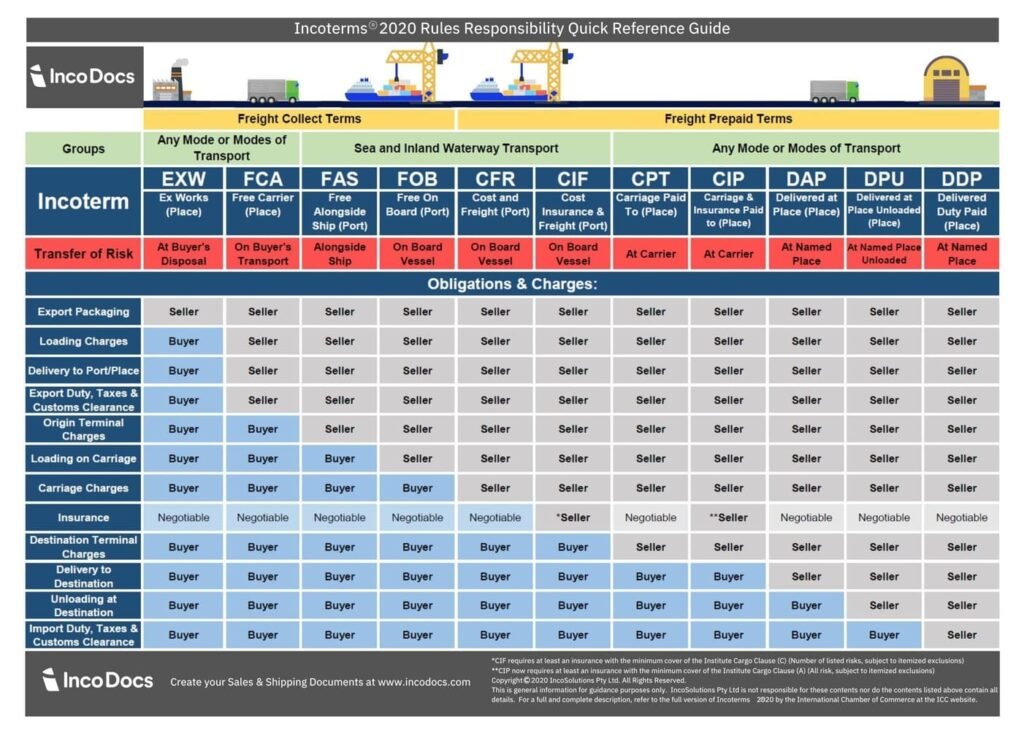
Ex work is the seller’s obligation to provide the goods at their own premises, namely at a factory or warehouse. People also refer to this term as a ‘franco warehouse’ sale. Under the EXW concept, the buyer arranges the transportation of the export goods themselves, bears the costs and risks, and takes care of the export permits. The seller’s responsibility under this concept is minimal because the buyer purchases the goods directly from the seller’s warehouse or through cash and carry.
FAS (Free Alongside Ship)
Under FAS, the seller’s obligation is to deliver the goods cleared for export, shipside, dockside, or bargeside at the port of loading. Therefore, the buyer is responsible for the costs and risks of loss or damage to the goods once they arrive at the shipside. The seller’s responsibility is to notify the buyer of the arrival of the goods and submit the necessary documentation.
FOB (Free on Board)
FOB means the seller delivers the goods on board the ship, or clean on board. In this term, the buyer arranges transportation, pays for freight, and covers insurance. Risk transfers from the seller to the buyer once the goods pass the ship’s rail. Most businesses prefer the FOB trade agreement for international shipping
By using this incoterm, the seller benefits include: (1) the port of loading is in their own country, where the seller is familiar with the country’s conditions, taxation, and customs regulations, and (2) the seller can avoid fluctuations in freight rates and foreign exchange rates.
CFR (Cost and Freight)
CFR is a term where the seller bears the freight costs to the destination specified by the buyer. The risk of damage or loss of exported goods passes from the seller to the buyer once the goods pass the ship’s rail. CFR can be advantageous for the seller if large exporters can choose more favorable terms from the carrier. CFR also benefits the buyer because under this term, the seller can arrange transportation and avoid rate fluctuations.
CIF (Cost Insurance and Freight)
CIF is similar to CFR, but the seller also bears insurance costs until the goods reach their destination. Therefore, the seller delivers the exported goods in a clear condition for export.