
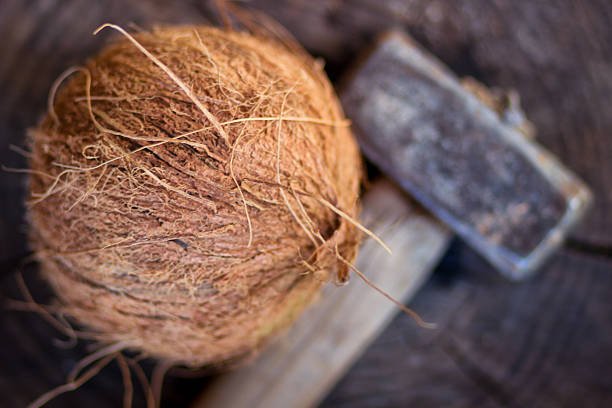
GETTING TO KNOW COCONUT PLANT: THE HEALTH BENEFITS OF COCONUT – INDONESIAN COCONUT FIBER PROCESSED PRODUCTS ARE SELLING EXPORTED – Taxonomy: This chapter will comprehensively discuss the taxonomy and anatomy of coconuts to identify and differentiate them from other palms. This section describes coconut growth requirements, types available, and how we produce them
A. COCONUT PLANT TAXONOMY
Coconuts, or Cocos nucifera, are an important crop for people in Southeast Asia, the Pacific, Africa, and parts of Latin America. Cocos is Latin for “monkey,” referring to the hairy fruit with three holes at the top of the coconut shell that resemble eyes and are home to apes. Nucifera means fruit-producing. We define producing fruit as Nucifera.
The Big Indonesian Dictionary defines a coconut as a tall palm plant that produces fruit covered in fiber and a hard shell. Inside is flesh containing coconut milk and water, and it is a multipurpose plant.” Coconuts are members of the palm family (Arcaceae). The general characteristics of palms are as follows:
- The upright trunk rarely develops branches, which is characteristic of the coconut tree.
- Stem segments alternate and lack true cambium, which makes the trunk segmented.
- The roots grow from the base of the trunk in the form of fibrous roots.
- The leaves are compound and grow along the leaf stalk.
- The leaf stalk has a leaf sheath that wraps around the trunk.
- The plant forms the flowers in a garland (manggar/mayang).
- A relatively thick outer layer, usually called sabut (fiber), covers the fruit.
- Coconut seeds harden from liquid; nevertheless, the tree produces 80–150 fruits even if neglected.
Coconuts are plants with a single trunk, or in some cases, branches. The trunk forms after five years of planting. The coconut trunk grows a single shoot.
The monocot trunk lacks cambium; thus, it cannot repair injuries, which prevents death from bark peeling
GETTING TO KNOW COCONUT PLANTS: HEALTH BENEFITS OF COCONUT – INDONESIAN COCONUT CORN PRODUCTS ARE SELLING EXPORTS