
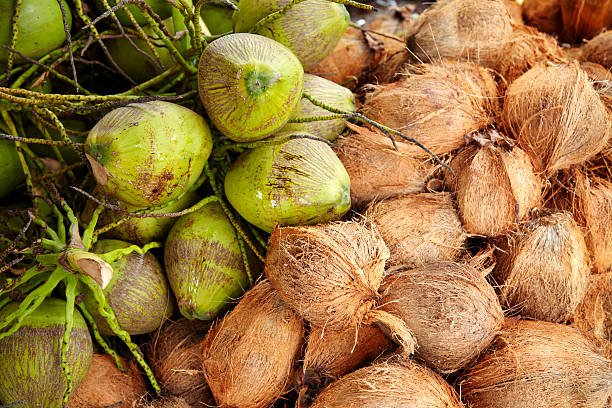
The coconut is a plant with thousands of uses. eople can process or utilize almost every part of the plant for daily needs, from the roots and trunk to the fruit and leaves. Coconuts have become a part of everyday life. People appropriately nickname the coconut the “tree of life.” You can eat the flesh of the young fruit and drink its water. Manufacturers transform the mature fruit into a distinctively flavored coconut sugar. Manufacturers transform the mature fruit into a distinctively flavored coconut sugar.
The benefits of coconuts are truly comprehensive. Farmers harvest and process coconuts and other useful parts of the plant. The following sections briefly explain harvesting and processing:
A. Various Harvesting Methods
Coconuts begin to grow and bear fruit at different times, depending on the coconut variety. Tall coconuts can grow in 5-6 years, dwarf coconuts and hybrid coconuts in 3-3.5 years. The productive lifespan of coconuts also varies. Dwarf and hybrid coconuts reach peak productivity at 25 years, while tall coconuts reach 55 years.
This declines gradually, lasting up to 70 years for tall varieties and 30 years for dwarf and hybrid varieties. The coconut fruit’s position directly under the canopy makes harvesting difficult. Furthermore, coconuts are monocotyledons, growing only orthotropically, or vertically. Unlike other fruit trees that branch and grow palgiotropically, or sideways, coconut trees grow taller over time. It’s not unusual for farmers in some Pacific countries, such as Papua New Guinea, to let the coconuts fall and then collect them.
In Indonesia’s coconut-growing regions, picking coconuts has become a separate activity. Farmers no longer pick all the coconuts themselves, but rely on handpickers. Growers usually perform harvests every 1–2 months to maximize efficiency and reduce costs. In areas with abundant labor and low costs, farmers harvest monthly. In locations with labor shortages and high wages, farmers generally harvest every two months. If the harvesting rotation is longer than two months, many coconuts will have fallen to the ground, and their quality will decline.
The management will delay any further canopy clearing. On the other hand, a harvesting rotation of less than one month is inefficient because only a few coconuts are fully ripe. Farmers who harvest once a month wait for the fully ripe fruit to fall naturally. Generally, they harvest two to three bunches at a time. This method does not significantly affect the quality of the fruit.
J.A. Banzon, a researcher at the Philippines Coconut Research and Development Foundation (PCRDF), stated that the fatty acid content of coconut oil from bunches three months younger is the same as that from fruit harvested on time, thus reducing harvest costs. Harvest time is from morning to evening, provided the weather is favorable. The following are coconut harvesting techniques from various regions in the archipelago and abroad. Only these three regions in Indonesia employ this unique harvesting method.Observers believe the coastal coconut farmers in three provinces are responsible. This actually originated from one region, Indragiri Hilir. Indragiri Hilir is an area where farmers have developed a coastal plantation system using the principle of three water systems. Workers use ditches as part of the system by dropping harvested coconuts into them. Thus, the use of unhusked rice for harvesting is highly appropriate for this treatment.
Coastal coconut plantations utilizing water management principles developed in Indragiri Hilir in the early 1980s. This area has long been the center of coconut plantations in Sumatra. During the colonial era, traders transported copra from Indragiri Hilir to Jakarta for export or shipped it to Singapore by wooden ships. The people of Indragiri Hilir prospered and enjoyed the glory days of coconut farming. Coconut farmers in Indragiri Hilir later migrated to areas to the east, namely West Tanjung Jabung, East Tanjung Jabung, and Banyuasin.
They migrated as their families grew and developed new coconut plantations in Tanjung Jabung and Banyuasin.
Not only did they introduce the “three tatari” aquatic system, but they also revolutionized coconut farming,
but the farmers also introduced other farming principles and harvesting methods to this new location. Coastal farmers utilize the tidal zone to lift water and transport coconuts, harvesting the fruit and dropping it into ditches during high tide.
Workers gather the coconuts and then float them down the river. The process of transporting or moving thousands of harvested coconuts has become easier.The pole-harvesting practice also traveled with them to their new plantations. The length varies depending on the height of the tree. Workers typically splice bamboo to create these poles. You can use bamboo poles to harvest coconuts from taller trees. The pole-holding technique also requires skill. The cutting must be precise to ensure the coconut bunches are secure.