
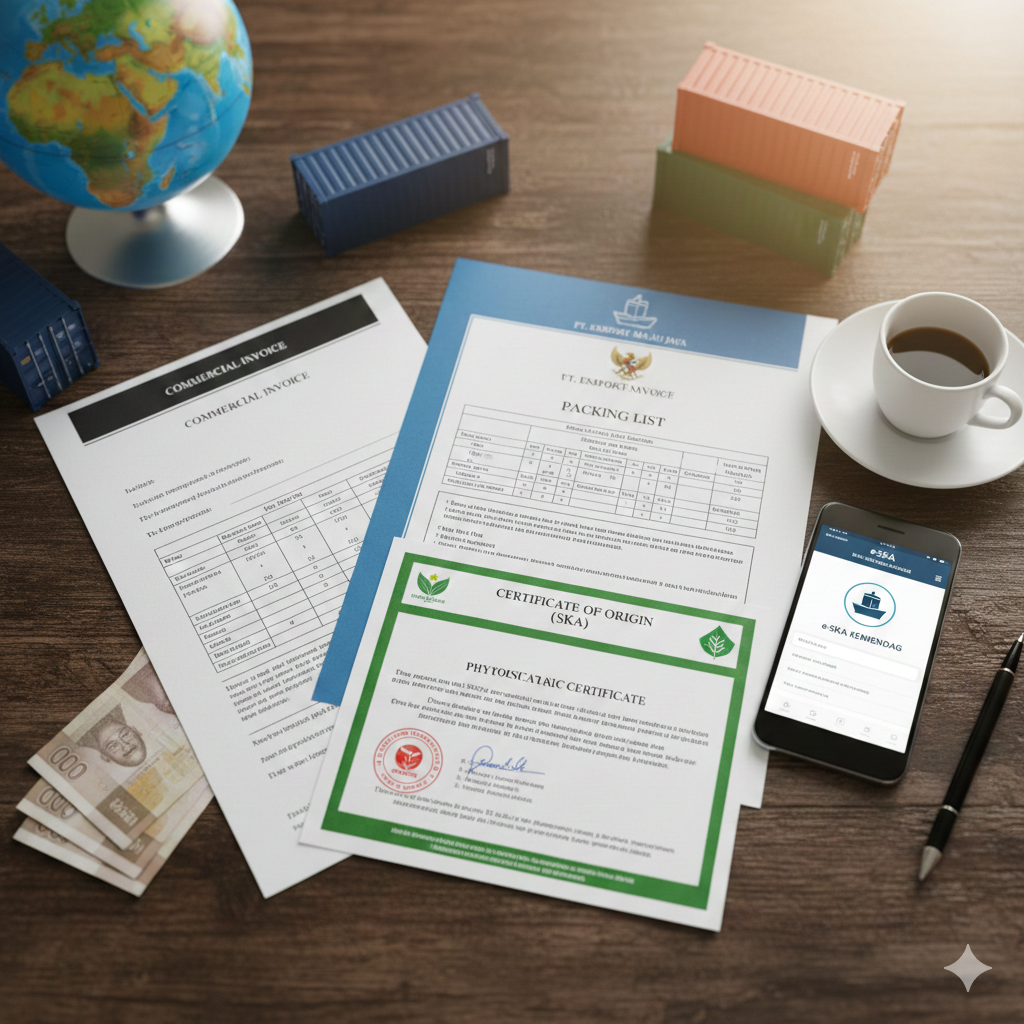
This is a mandatory document for every export activity. There are three main types of documents:
Invoice (prepared by the Exporter)
An invoice, often called a bill or memorandum in Indonesia, is a document that serves as proof of a transaction or billing statement from the exporter to the importer. The invoice includes the invoice number and date, the name of the goods, the unit price and total price, the name and address of the exporter, the name and address of the importer, and payment account details, if necessary. The invoice is prepared on the exporter’s letterhead.
Packing List (prepared by the Exporter)
A packing list is a document prepared by the exporter that details the specifications of the goods. It includes the name of the goods, the packing list number and date, the number of packages (packs/pieces/bundles/cans/cartons/sacks), the net weight, and the gross weight. A packing list is similar to a waybill used domestically for shipping goods.
Bill of Lading (issued by the shipping company) or Airwaybill (issued by the airline)
A Bill of Lading (B/L) is proof of shipment or a receipt issued by the shipping company to the exporter after the ship departs from Indonesia. The B/L can also serve as a document of ownership of the goods. Therefore, a B/L is a valuable document, and the holder of the B/L is the owner of the goods listed therein.
ADDITIONAL DOCUMENTS DURING EXPORT
This document is not mandatory. This means it only needs to be processed or created and included if requested by the buyer or due to regulations in the buyer’s country. Additional documents may also be required for some products due to requirements in Indonesian regulations. These additional documents are as follows:
CERTIFICATE OF ORIGIN
(FROM THE DISTRICT OR CITY, PROVINCE, AND THE PROVINCIAL DISTRICT)
A Certificate of Origin (COO) or Surat Keterangan Asal (SKA) is an additional document issued by the local Department of Industry and Trade (Disperindag) of the Regency/City/Province. This document certifies that the goods originate from our own country, Indonesia.
The COO document can be used by buyers to obtain import duty relief in their country, even reducing import duties to 0%.
Generally, the COO is useful for importers from countries that have entered into the ASEAN Economic Community (AEC) cooperation, which involves ASEAN countries.
As part of ASEAN, Indonesian exporters can benefit from FTAs with partner countries within their respective cooperation frameworks, namely ASEAN-China (AC-FTA), ASEAN-FTA (CEPT-AFTA), ASEAN-Korea, ASEAN-India, and ASEAN-Australia-New Zealand. Indonesia also has direct agreements with Japan (IJ-EPA), Pakistan, and Australia.
TYPES OF REGIONAL FREE TRADE AGREEMENTS
(Indonesian Government Agreements with Regional Areas and Types of Certificates of Origin)
- ASEAN Trade in Goods Agreement (ATIGA) – Form D
- ASEAN – Australia – New Zealand Free Trade Area (AANZFTA) – Form AANZ
- ASEAN – India Free Trade Area (AIFTA) – Form AI
- ASEAN – Korean Free Trade Area (AKFTA) – Form AK
- ASEAN – China Free Trade Area (ACFTA) – Form E
- ASEAN – Hong Kong, China FTA & Investing Agreement – Form AHKFTA
- ASEAN – Japan Comprehensive Economic Partnership (AJCEP) – Form AJCEP
TYPES OF BILATERAL FREE TRADE AGREEMENTS
(Indonesian Government Agreements with other countries and Types of Certificates of Origin)
- Indonesia – Japan Economic Partnership Agreement (IJEP) – Form IJEPA
- Indonesia – Pakistan Preferential Trade Agreement Agreement (IP – PTA) – Form IP
- Indonesia – Chile Comprehensive Economic Partnership Agreement (IC – CEPA) – Form IA – CEPA
- Indonesia – Australia Comprehensive Economic Partnership Agreement (IA – CEPA) – Form IA – CEPA
- Indonesia – European Free Trade Association Comprehensive Economic Partnership Agreement (IE – CEPA) – Declaration of Origin (DAB)
The COO document can be used for products listed in each FTA agreement. Besides being prepared in-house, the COO can be handled by a forwarder, for an additional fee, in addition to the forwarder’s service fee. The COO can be prepared electronically (online), called E-SKA, through the website http://e-ska.kemendag.go.id/. However, to obtain approval and print the original COO document, you must visit the Department of Industry and Trade office that issued the COO, bringing important required documents, such as the PEB, Invoice, Packing List, and Bill of Lading.
CERTIFICATE OF ANALYSIS (FROM THE MANUFACTURER OR (LABORATORY)
A Certificate of Analysis (COA) is a supplementary document containing the analysis results of a shipped product. The analysis is carried out according to the buyer’s request or applicable general standards. The Certificate of Analysis can be prepared by the exporter themselves or through an accredited independent laboratory. Generally, COAs are only used for certain products, such as chemical or agricultural products, to ensure the product’s content. Examples of products that require COAs are essential oils and mining products.
Phytosanitary Certificate from the Quarantine Agency
A Phytosanitary Certificate is a supporting document commonly used for agricultural products. This document guarantees that the exported product is free from disease-causing germs such as fungi or bacteria.
Phytosanitary certificates are issued by the Agricultural Quarantine Agency office located at each export port or its representative offices in several cities. Examples of products that require this document include fresh fruit, spices, and other agricultural products.
In addition to plant products, quarantine documents are also required for animal products from animals and fish.
These three documents are examples of types of Additional documents requested by the buyer if required by the destination country. In addition to these three additional documents, buyers may also request other additional documents depending on the type of goods to be exported, such as a fumigation certificate, a health certificate, and a veterinary certificate.