
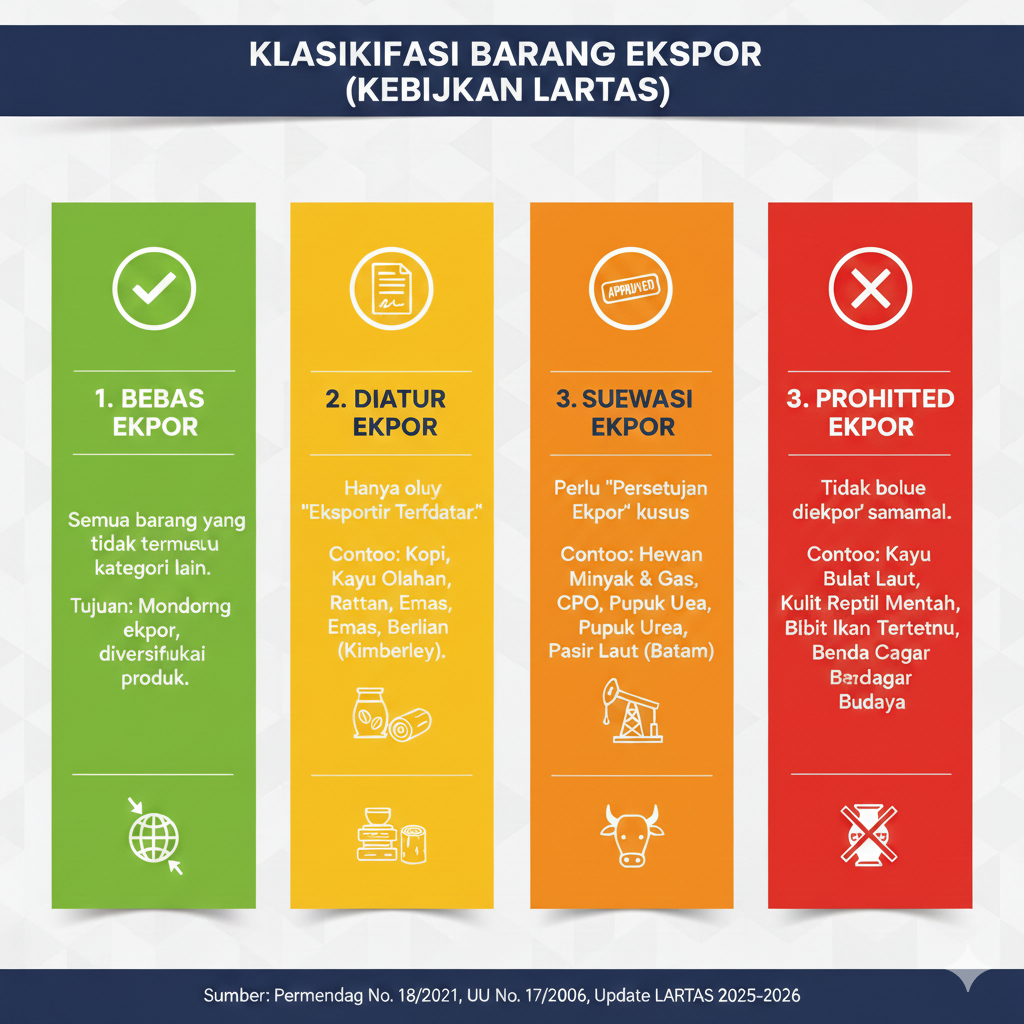
A. CLASSIFICATION OF EXPORT GOODS
Not all types of goods can be exported. For certain reasons, the government regulates which products can and cannot be exported. This policy is based on applicable regulations, known as the Export Prohibition and Restriction Policy (Lartas Ekpor). This policy contains decisions to prohibit or restrict the export of certain goods.
Export goods are grouped into three categories: prohibited export goods, restricted export goods, and free export goods.
The export prohibition policy is regulated in various laws and regulations, such as Article 53 of Law Number 17 of 2006, Law Number 10 of 1995 concerning Customs, Minister of Finance Regulation Number 141/PMK.04/2020 concerning the supervision of imports and exports of Lartas goods, and Minister of Trade Regulation Number 18 of 2021 concerning Export Prohibitions. There are many reasons why the export of a product is prohibited or restricted, such as ensuring the availability of raw materials for the country, protecting the environment, increasing productivity, increasing added value, and other reasons related to national interests.
The law stipulates that export goods are classified into four groups: (1) regulated export, (2) supervised export, (3) prohibited export, and (4) free export.
TYPES OF GOODS SUBJECT TO EXPORT REGULATION
Types of export goods in this group are only exported by registered exporters due to international agreements or regulations. Registered exporters are companies or individuals recognized by the Ministry of Trade to export certain goods, in accordance with the expected regulations.
BASIC CONSIDERATIONS FOR DETERMINING WHETHER A GOOD IS SUBJECT TO EXPORT REGULATION INCLUDE
- Adhering to international regulations
- Maintaining environmental sustainability
- Increasing added value
- Increasing foreign exchange and competitiveness
- Availability of raw materials
SOME GOODS SUBJECT TO EXPORT REGULATIONS ARE:
- Plantation products: roasted/unroasted coffee, processed coffee
- Forestry products: rattan and wood products
- Industrial products: anhybrid acetic acid, phenylacetic acid, acetone, butanol.
- Mining products: diamonds, tin bullion, gold, precursors
The export of coffee products is regulated to comply with the International Coalition for Trade and Investment (ICO) agreement, as well as to increase added value and maintain coffee price stability. Meanwhile, export trade regulations for forestry industry products must be regulated for several reasons, namely:
- Exports are directed towards forestry industry products, which are final products, not raw materials.
- To preserve forest resources, (3) to ensure the fulfillment of domestic industrial raw material needs, and (4) to increase the added value of forestry industry products. The export of rattan products is regulated to preserve forest resources and ensure the fulfillment of domestic industrial raw material needs. The export of rough diamonds is also regulated, following the Kimberley Process Certification Scheme, which aims to combat diamond trafficking in the international market. Precursor exports are controlled by the Besel Convention, which aims to combat the misuse of precursors as raw materials or auxiliary materials for the illicit manufacture of narcotics and psychotropic substances. Meanwhile, exports of tin ingots are regulated due to uncontrolled mining of tin ore or tin sand, which has resulted in environmental damage, and to increase added value by complying with applicable international quality standards.
TYPES OF GOODS SUBJECT TO EXPORT CONTROL
Export control is a group of goods whose export may only be undertaken by exporters who have received approval from the Ministry of Trade, a designated official, or a special exporter. The export of certain goods is controlled for certain reasons, such as:
- Meeting domestic needs
- Environmental sustainability
- Efforts to encourage industrial development, as domestic products are needed by farmers, SMEs, or artisans.
Export-controlled goods include: - Livestock products: live cattle, cattle stock, non-cattle stock, buffalo, crocodile skin, wet blue, wild animals, and plants (Appendix II cites)
- Fishery products: Napoleon wrasse, Napoleon wrasse, milkfish fry
- Plantation products: palm kernel
- Mining products: oil and gas, coke/protein oil, precious metal ores, silver, gold, and
- Industrial products: iron/steel scrap (specifically from the Batam region), stainless steel scrap, copper, brass, aluminum, and urea fertilizer.
TYPES OF GOODS PROHIBITED FROM EXPORT
These types of goods are prohibited from exporting, meaning no exporters are permitted to export these goods. An item is classified as prohibited from export for the following reasons:
3. TYPES OF GOODS PROHIBITED FROM EXPORT
These types of goods are prohibited from exporting, meaning no exporters are permitted to export these goods. An item is classified as prohibited from export for the following reasons:
These types of goods are prohibited from export, meaning no exporters are permitted to export these goods. An item is classified as prohibited from export for the following reasons:
- The item is rare
- Efforts to preserve nature
- Does not meet quality standards
- Ensures raw material needs for small industries or artisans
- Increases added value
- Items of historical and cultural value.
Export-prohibited goods include: - Industrial products: raw, pickled, and wet blue hides from reptiles
- Livestock products: juvenile fish and arowana, eel fry, ornamental fish of the botia type, 8 cm giant prawns, and panedae shrimp
- Forestry products: roundwood, shale raw materials, railroad or tram scraps, and sawn timber
- Marine products: sea sand, inland sand, soil, and topsoil
- Mining products: tin ore, lump rubber, remailing and smokehouse materials, ash and residues containing arsenic, metals or their compounds, and others, especially those containing tin and precious stones.
4. TYPES OF GOODS THAT ARE FREE TO EXPORT
Export-free goods are all goods that exporters are free to export by following general regulations. These export-free goods include all goods not listed in the regulations above.
…
The basis for determining goods that are subject to free export is to encourage exports, through opening market access, increasing competitiveness, and increasing product diversification.